
Part 1 of the Gujarat Capital Series
Tracking how billions in international diaspora wealth and global financial flows are preparing to deploy across Gujarat's industrial, real estate, and infrastructure corridors.
Over the past several months, an unprecedented financial mobilization has taken place across international wealth desks. Global banking giants and Indian state lenders have engaged in a fierce, high-stakes battle to capture Non-Resident Indian (NRI) capital—channeling billions of dollars into Foreign Currency Non-Resident (FCNR) deposits, offshore accounts, and GIFT City’s International Financial Services Centre (IFSC).
While mainstream headlines covered these developments as routine deposit statistics, the underlying reality is a massive structural liquidity wave. For Gujarat’s business leaders, real estate developers, and industrial operators, understanding the mechanics of how this capital arrived is the essential first step to anticipating where it will be deployed next.
1. The High-Stakes Wealth War: HSBC vs. The Field
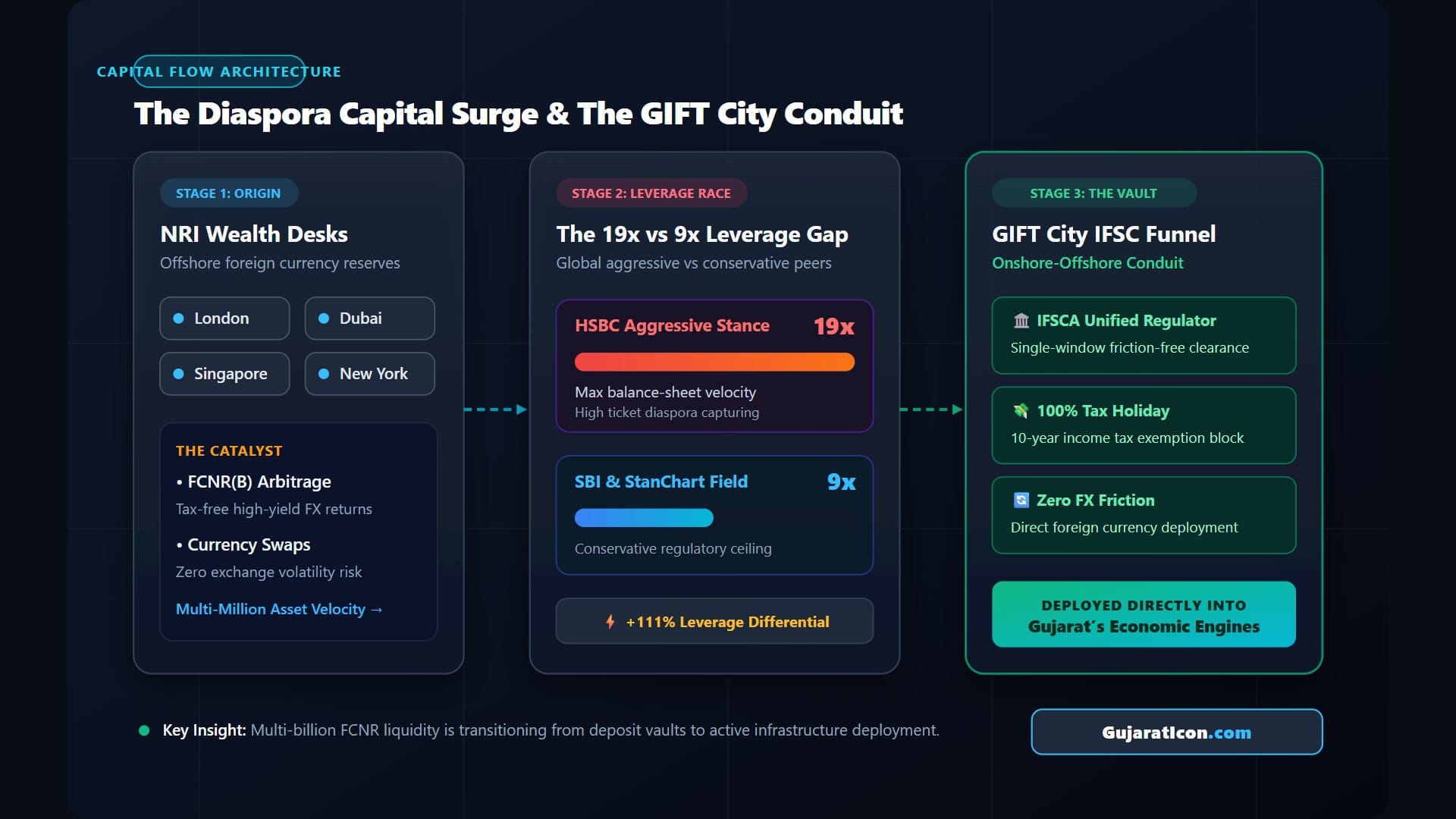
The catalyst began across private wealth desks in London, Dubai, Singapore, and New York. As interest rate environments shifted, global lenders realized that high-net-worth NRIs held immense, under-leveraged foreign currency reserves.
In an aggressive push documented by investigative coverage on Gujarat.News, institutions like HSBC pushed leverage ratios up to 19x on foreign currency deposits—dramatically outpacing conservative peers like State Bank of India and Standard Chartered, who maintained ceilings near 9x.
By leveraging deposit arbitrage and currency swap mechanisms, global banks turned the Indian diaspora into one of the most lucrative wealth-generation engines in international banking. As detailed in Gujarat.News’ analysis of NRI passport valuations, single-ticket diaspora relationships suddenly represented upwards of millions in balance-sheet velocity for international lenders.
2. The GIFT City Funnel
Simultaneously, the regulatory maturation of GIFT City provided the onshore-offshore conduit necessary to house these flows.
With tax holidays, zero currency conversion friction, and unified oversight from the International Financial Services Centres Authority (IFSCA), GIFT City became the natural institutional vault for cross-border Indian capital. Foreign currency deposits that previously sat dormant in Singapore or Dubai were actively routed directly into Gandhinagar’s financial district.
(For a tactical breakdown of how cross-border investment frameworks function under the revised rules, read Gujarat.News’ step-by-step GIFT City guide).
3. The Ticking Clock: Why Capital Must Move
Capturing deposits is only the liability side of the banking ledger. FCNR deposits and structured foreign debt instruments carry a defined cost of capital and fixed redemption horizons (typically 3 to 5 years).
Money sitting in a vault earns zero spread.
Because banks have taken on substantial interest obligations to secure this diaspora liquidity, the clock is actively ticking. Financial institutions, infrastructure funds, and private equity vehicles must now aggressively originate loans, fund capital expenditures, and underwrite productive assets to generate matching yields.

What This Means for Urban Gujarat
This global wealth battle was not an isolated financial exercise—it is the upstream engine powering the next phase of Gujarat’s physical growth.
As this capital is unbundled and channeled through institutional pipelines, it will directly feed:
Mega-Infrastructure Financing:
Accelerating major corridors like the Dholera SIR and regional high-speed rail.
Commercial & Industrial Real Estate:
Meeting the massive demand for grade-A office space, hyperscale data centers, and specialized manufacturing parks.
MSME Credit & Supply Chains:
Powering the vendor ecosystems required by the state’s semiconductor fabs and heavy manufacturing plants.
The Road Ahead: The Gujarat Capital Series
In this multi-part investigation, GujaratIcon will trace the direct pipeline from international balance sheets to ground-level opportunities across the state:
Part 1 (Today):
The Diaspora Capital Surge: How Global Banks Triggered Gujarat’s Influx
Part 2:
The Ticking Clock on Balance Sheets: Where Banks Must Deploy Liquidity in Q3/Q4
Part 3:
The GIFT City Real Estate Spillover: Commercial Absorption in Ahmedabad & Gandhinagar
Part 4:
Beyond the Fab: How MSMEs Can Capture Dholera’s Semiconductor Capital
Part 5:
Transit-Oriented Land Arbitrage: Monetizing the Namo Bharat and Metro Corridors
Stay tuned as we follow the capital trail across urban Gujarat.
Sources:


